
Bijeenkomsten
Op deze pagina vind je de workshops en lezingen die het Duitsland Instituut Amsterdam organiseert in het kader van het Graduiertenkolleg. Voor actuele wetenschappelijke bijeenkomsten en projecten kijk ook op Wetenschap uitgelicht.
Graduiertenkolleg | Governing Islam in Colonial Times met Farid Hafez
24 juni 2026, 14.00-17.00
Bushuis/Oost Indisch Huis, E1.01E
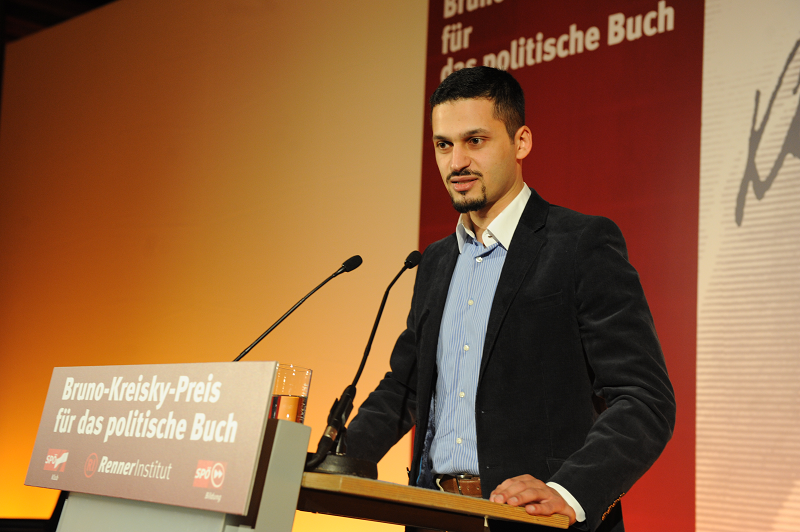
Foto via Wikimedia: Fatih Öztürk, Hafezrede, CC BY 3.0
In his latest book on the governance of Islam in Austria and Germany, Farid Hafez shows how the state aims to regulate and govern a racialized version of Islam and Muslims, grounded in history. After analyzing the Austro-Hungarian rule over Bosnia and Hercegovina and the German Kaiserreich’s rule in Tanzania, Togo, and Cameroon in respect to its Muslim subjects, he argues that the continuities with the Nazi Reich’s incorporation of Muslims in its polity as well as contemporary Islam policies in postwar Austria and Germany are striking.
- Farid Hafez (Williamsburg, VS), Governing Islam in Austria and Germany: From Colonial Times to the Present
- Nuri Kurnaz (UvA), Imperialism, Islam and Anti-colonial thought in the interwar period
- Rukayyah Reichling (UvA), Photographs, film and sound recordings from Mecca during late colonial times
Moderation Hanco Jürgens, DIA/UvA.
Organized by DIA, together with the research group Global Islam, UvA
Aanmelden bij Hanco Jürgens: h.j.jurgens@uva.nl
Mini-workshop | Problems of historicizing the Far Right in Germany and Europe, with Dr. Barbara Manthe (Bielefeld)
17 juni 2026
Following her public lecture in SPUI25 (Tuesday, 16 June, 20:00), Dr. Barbara Manthe will meet UvA researchers and students to discuss general questions on the history of the Far Right in Germany and Europe. What are the key questions and problems in this field of research today? How do researchers from varying disciplines approach the object of study? What are the implications for our writing of the history of democracy, of political representation, of protest and violence? How do we deal with the many competing definitions in the field – ranging from populism, extremism, terrorism or (new) nationalism? The workshop will include short pitches by researchers from the UvA and the DIA, feeding into the discussion with Dr. Manthe. More information (pdf).
Please send an email to Krijn Thijs if you want to attend: k.thijs@uva.nl
Round Table | Intellectual history and the history of the body
5 juni 2026
In the search for new approaches to history, one soon encounters both a global, intellectual, as well as a bodily turn. In this workshop, we will talk about ways to combine these fields of study, about possible crossovers, and about what could be learned from successive approaches. Are there any pitfalls, or could one benefit from a global, intellectual history of the body, or of a corporeal intellectual global history? Many questions will be answered in an open workshop with esteemed experts in the fields.
- Sebastian Conrad (FU Berlin), Introduction
- Willemijn Ruberg (UU), History of the body from a local, European and Global Perspective
- Serena Ferente (UvA), ‘The Body and Political Thought’ in Europa and East Asia (ca. 1150–1650)
- Josephine Hoegaerts (UvA), Modern Voices from a local as well as global Perspective
- Nuri Kurnaz (UvA), ‘Ideas on European Integration in the Era of Colonialism, 1920s-1930s’.
Moderatie en aanmelding: Hanco Jürgens (DIA): h.j.jurgens@uva.nl
Organized by DIA, together with the research group Global Political Thought, UvA
rMA and PhD workshop: Das liebende Ich. Subjektkonzepte in der Literatur der Weimarer Republik
23 april 2026
Op 23 april (15-18 uur) nodigen wij masterstudenten, PhDs en onderzoekers uit voor een workshop aan de Universiteit van Amsterdam, met literatuurwetenschapper Carmen Ulrich (Wuppertal/München). Zij geeft een lezing met de titel Das liebende Ich. Subjektkonzepte in der Literatur der Weimarer Republik. Tussen emancipatie en massacultuur is het 'ik' van de Weimarrepubliek op zoek naar zichzelf – en naar de Ander. Van de extatische doorbraak van het expressionisme tot de nuchtere helderheid van de Neue Sachlichkeit verschuift de positie van het literaire ik: in plaats van de onmiddellijke beleving treedt de gereflecteerde ervaring op de voorgrond. In het spanningsveld tussen intimiteit en openbaarheid, zelfovergave en autonomie ontstaat een literatuur die de liefde niet alleen vertelt, maar haar ensceneert als een mogelijkheid tot dialoog.
Op de lezing volgt een gezamenlijk gesprek, waarbij ook Gertrud Kolmars gedicht Die Verlassene wordt betrokken. De voertaal is Duits. Voor meer info en aanmelden mail naar Julia Augart: j.augart@uva.nl.
Das Aufheben von Meinungen. Bildung als Aufklärung und das Problem des politischen Irrationalismus
Onderzoekslunch op 10 maart met Simon Helling (Berlin)
In vielen Ländern der Welt zeigen sich irrationale politische Meinungen immer unverstellter. Damit diese Meinungen nicht noch mehr in die handfeste Gewalt umschlagen, als sie es ohnehin schon tun, wäre über sie aufzuklären. Einer der elaboriertesten Versuche, den Aufklärungs- als Bildungsprozess darzustellen, ist Hegels Phänomenologie des Geistes. Sie ist als stets neu ansetzendes Aufheben von Meinungen konzipiert. Von dieser Konzeption kann auch ein gegenwärtiges Nachdenken über Bildung, gerade im Kontrast zu gängigen didaktischen Vorstellungen, profitieren. Allerdings widersteht die Gestalt des politischen Irrationalismus dieser klassischen, als Fortschritt gedachten Konzeption. Adorno und Horkheimer sprachen daher in Bezug auf den Antisemitismus von den Grenzen der Aufklärung. Welche Gestalt könnte eine Aufklärung über den politischen Irrationalismus dennoch haben?
Alle geïnteresseerden zijn van harte uitgenodigd om mee te doen. Registreren kan via e-mail naar: h.balz@uva.nl
"Rechtsextremisme in Duitsland”
Onderzoekslunch op 14 april met dr. Erik van Ree (DIA)
Mijn onderzoek de komende jaren betreft de politieke filosofie/staatsopvattingen van rechtsextremisten in Duitsland en de VS na de Tweede Wereldoorlog, i.h.b. de afgelopen decennia. Rechtsextremisten hebben veel te zeggen over van alles (klimaat, migratie, EU, gender, etc.), maar zijn terughoudend over de staatsvorm die ze beogen: wat hebben ze in gedachten qua democratie en dictatuur? Wel circuleren er gedachten (en praktijken!: VS, Hongarije, Rusland) over toekomstige staatsordeningen, bijv. illiberale democratie; etnostaat; individuele souvereiniteit; elite-heerschappij; en directe democratie en milities.
Relevante vragen: hoe definiëer je fascisme, rechtsextremisme etc.? Hebben deze mensen überhaupt ideeën of gaat het ze uitsluitend om macht? Op welke tradities grijpt men terug: nazisme, fascisme, “conservatieve revolutie”, het oorspronkelijke neo-liberalisme, libertarisme?
Alle geïnteresseerden zijn van harte uitgenodigd om mee te doen. Registreren kan via e-mail naar: h.balz@uva.nl
"Efforts of the Mother, Sorrows of the Father: The Image of the Jewish Pupil in Schoolbooks (1796–1871)”
Onderzoekslunch op 12 mei met Kyra Gerber (DIA)
During the early nineteenth century, schooling underwent profound changes and was increasingly placed under the supervision of national governments. Both from within the Jewish community and from the outside of it, through official state institutions, a reformed school system was introduced. Traditional tuition, often provided in Yiddish, was gradually replaced by education in secular, religious, and practical subjects taught in the respective national language. This presentation explores the fascinating genre of Jewish schoolbooks published between 1796 and 1871 and examines how their authors consciously, and at times unconsciously, sought to shape a new generation. We will discuss broader themes such as moral instruction and the differences between boys’ and girls’ education, while also highlighting intriguing particularities. For instance, some Dutch schoolbooks required Jewish boys to learn how to swim, considering it essential in a country defined by its waterways.
Alle geïnteresseerden zijn van harte uitgenodigd om mee te doen. Registreren kan via e-mail naar: h.balz@uva.nl
"Theater als geschiedschrijving"
Onderzoekslunch op 9 juni met Ezra Engelsberg (DIA)
Toneelschrijvers baseerden hun historische drama’s niet alleen op antieke bronnen, maar gebruikten het theater ook om met diezelfde bronnen in dialoog te gaan. Vanmiddag kijken we naar een aantal voorbeelden van theatrale interventies in de historische canon van de Joodse oudheid.
Alle geïnteresseerden zijn van harte uitgenodigd om mee te doen. Registreren kan via e-mail naar: h.balz@uva.nl
rMA and PhD workshop: Histories of taxation, (in)equality, and redistribution
13 February 2026
In this workshop, we will discuss how historians could benefit from the studies of taxation and how we should understand the changing political regimes on equality. Finally, we will learn how important taxation was for maintaining colonial power ‘relations’.
Speakers:
- Marc Buggeln (Flensburg), Tax regimes and equality: why study the history of taxation
- Marjolein ’t Hart (VU/Huygens (invited), Why Taxes Are Good for Democracy: State Formation and Political Culture in a World-Historical Perspective
- Maarten Manse (Linnaeus University), Compromise and adaptation in colonial taxation: fiscal ideology, policy, practice and inequality in colonial Indonesia, ca. 1870-1920’
Location: Amsterdam city centre (exact venue TBA)
Admission: Free, but please register by sending an email to: bureau@onderzoekschoolpolitiekegeschiedenis.nl before 6 February 2026. Please include in your registration a one-page statement reflecting on how the history of taxation could provide new perspectives on your research.
Credits: 1 EC
Organisation: Duitsland Instituut Amsterdam & Onderzoekschool Politieke Geschiedenis
Read more about this workshop (pdf).
 2025
2025